
First Tattoo Tips: From the First Idea to a Healed Tattoo
Adem Hajdarević2026-11-12T09:00:00+00:00So you're thinking about your first tattoo. Good. It is one of the few choices you carry for the rest of your life, which is exactly why it deserves some thought before anyone opens a needle. These first tattoo tips come from my side of the work, as a tattoo artist and graphic designer who draws his own tattoo artwork.
None of it is complicated. Most of it comes down to asking the right questions in the right order: what you want to say, which style says it, how big it has to be, and where it should sit. Then come the day itself and the healing. I'll talk it through the way I would with a friend showing me a sketch on their phone.
Start with an idea that will still mean something
Here is the first question I would ask: will this still feel like yours once the trend that put it in your head has gone quiet? A tattoo is permanent, and some can't be fully removed later. So give the idea time.
Ideas that last come from somewhere real: the street you grew up on, a person, a plant from your grandmother's garden, a song that got you through a hard year. It can be private, even a little silly, as long as it belongs to you. An image copied from a stranger's arm has none of that.
And if you're unsure? Wait. Your skin has no deadline, and nobody else should be pushing you into it.
Picking a style that fits the idea
Once the idea feels settled, the next question is how it should look. The same wolf can turn into four very different tattoos depending on the style.
Want something bold that reads from across the street? A blackwork tattoo works with solid black areas and strong shapes. If you'd rather keep it light, a fine line tattoo leans on thin, clean lines and plenty of open skin. Patterns built from countless tiny dots, mandalas among them, belong to dotwork and ornamental tattoos. And when colour is the whole point, colour and watercolour tattoos bring in soft washes or full, saturated tones.
Still not sure which one is you? Save the tattoos you keep coming back to and look at what they share. Usually the style has already picked itself.
Size and detail: fine detail needs room
This is where I am most likely to push back. Lots of first tattoo ideas arrive tiny and packed: a whole landscape, a face, a long sentence in small script. On paper, that looks lovely.
Skin isn't paper, though. It moves, stretches, and ages with you, and lines drawn very close together have nowhere to go. Over the years, the gaps between them can soften, until what looked crisp on the first day reads as a grey patch from a few steps away.
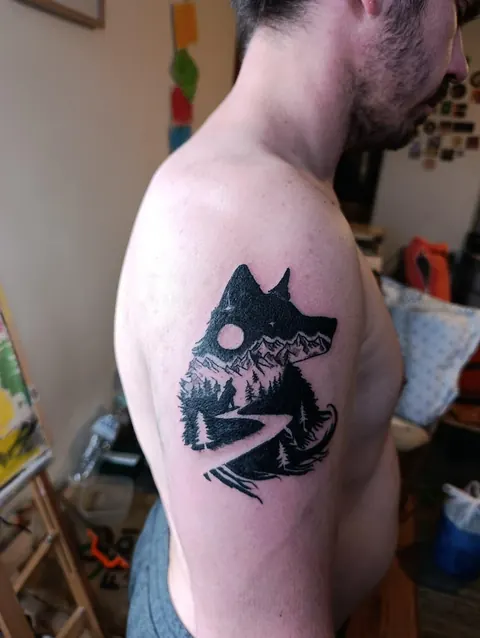
Give the detail room to breathe. One of the tattoos in my gallery is a wolf head on the upper arm, with mountains, pine trees, a full moon, and a tiny walking figure inside the silhouette. It works because it has room. Shrink it to the size of a coin and that little figure would be the first thing to go.
Small can be beautiful. It just asks for a simpler drawing.
First tattoo placement: where it lives on you
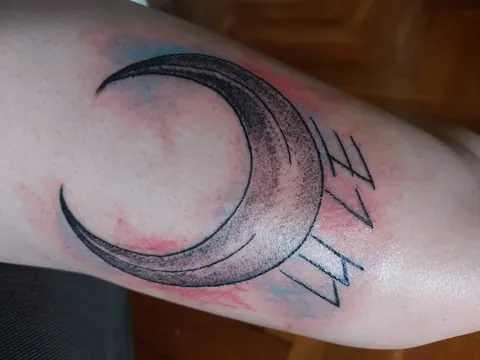
Placement decides how often you see the tattoo, who else sees it, and how the design moves when you move. A long, narrow piece wants a long, narrow spot. One of my linework tattoos is a column of Nordic style symbols running down a forearm, and that shape only makes sense there.
Think about everyday life as well. Do you want it on show at work, or tucked under a sleeve? Bodies change too: weight gain, pregnancy included, can change how a tattoo looks. Worth keeping in mind, nothing more.
Then there is pain, since some areas are a lot more sensitive than others. I've gone through it area by area in my guide to tattoo placement and pain.
Look at healed work and a clean setup
Fresh tattoo photos flatter everyone: sharp lines, deep black, shiny skin. Ask any artist you are considering for healed photos too: they show whether the lines stayed clean and the shading settled evenly.
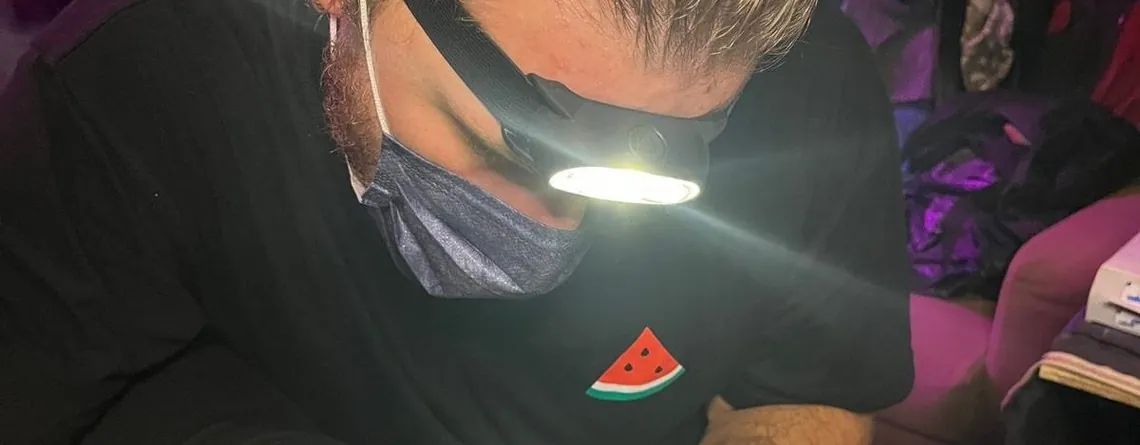
Hygiene is the other half, and you are allowed to watch it happen. The preparation photos on my tattoo page show that part of the work, and I wrote about why it matters to me in the post on how I started tattooing.
Before the first line goes in, look for these:
- A new needle from its own sealed package, used once
- New disposable gloves on the artist's hands, and a mask
- The machine and its cord wrapped in protective plastic
- A covered tray with new, single-use ink caps
From your idea to a custom tattoo design
Custom tattoo design is the part I enjoy most, probably because graphic design came first for me. Years of logos, book covers, and typography taught me that a good tattoo, like a good logo, has to work from a distance and up close.
It starts with what you send me: the idea, a few reference images, where it should go, and roughly how big. Then I sketch, test the size and colours digitally, and rework the lines until they sit right on the body. Sometimes the first sketch is close. Sometimes we start again, and that's fine.
If you have an idea, write to me about your tattoo design, and I'll answer by email.
Getting ready for the day of your tattoo
Start with the skin on the area: it should be healthy and unbroken, so if it is sunburnt, scratched, or irritated, tell your artist beforehand.
Medicines deserve their own mention. If you take anything regularly, let your artist know ahead of time, because some medicines affect how the skin heals or how easily you bleed. When in doubt, ask your doctor first, and the same goes for any health condition, such as diabetes or a tendency to allergies.
The rest is simple:
- Sleep properly the night before
- Eat a proper meal beforehand, and bring water and a snack
- Wear comfortable clothes that leave the area easy to reach
- Skip alcohol, and arrive with a clear head
What does a first tattoo feel like?
Honestly? It depends on you and on the spot. People describe a scratch, a hot line being drawn, or a buzzing sting, and the surprise is usually bigger than the pain itself.
Breathe, keep as still as you can, and tell your artist when you need a pause or a sip of water. A good artist would rather stop than watch you grit your teeth in silence.
Afterwards, the skin is sore and red, and a little ink mixed with blood can seep out. That is the body starting to heal.
Aftercare: the healing is part of the tattoo
Your tattoo isn't finished when the machine stops, because how it heals decides how it looks for years. The artist who made it will give you aftercare instructions. Follow those first, before any advice from a forum.
In general, keep it clean, don't scratch or pick at it when it itches and flakes, and keep it out of pools, baths, and direct sun while it heals. The full routine is in my guide to new tattoo aftercare.
Watch for signs of infection: pain that gets worse instead of better, bumps filled with pus, a bad smell or heavy discharge, or red streaks running from the tattoo. If you see any of them, go to a doctor, not to your tattoo artist. The same goes for an allergic reaction, like an itchy, bumpy rash.
Your skin can wait for the right idea
If one thread runs through all of this, it is patience: with the idea first, and later with the healing. The tattoos people still love years later are seldom the ones they rushed into. Make your first one something you will be glad to see in the mirror on an ordinary Tuesday morning.
When your idea feels ready, or even half ready, tell me about it. I'm always glad to hear a first tattoo idea and to think it through with you.