
Dotwork and Ornamental Tattoos
A dotwork tattoo gets its shading from small dots instead of solid black, while an ornamental tattoo grows out of mandalas, patterns, symmetry, and symbols. I am Adem Hajdarević, a tattoo artist and graphic designer living in Rome, and both styles keep showing up in my designs.
Here is how each style works and where the two meet, with four of my own pieces and a few notes on placement and healing. More of my tattoos are on my main tattoo page.
What a dotwork tattoo is made of
Dots, mostly. In a dotwork tattoo, the shading comes from single points of ink, and their spacing sets the tone. Packed tightly, they read as dark. Spread apart, they fade softly into the skin. Illustrators call it stippling.
What you get is a soft gradient with a fine grain that solid shading lacks. Step back and the dots melt into one tone; up close, each one is still there, a double reading I learned to value in graphic design.
Dotwork can carry a whole piece or just part of it, filling a shape or adding shadow under clean lines. So when I sketch, deciding where the dots go comes right after the main lines.
How an ornamental tattoo uses pattern and dots
Ornamental tattoos start from decoration rather than from a picture: mandalas, petals, borders, and small symbols, arranged around a centre or along a line. Symmetry holds them together. If one side of a mandala drifts even slightly, the eye catches it at once.
My design background helps most at this point. Years of logos and typography taught me to build on a grid and to balance weight on both sides of an axis.
Put the two styles together, and they fit easily. Inside an ornamental frame, dots work as shading; on their own, they become ornament. Plenty of dotwork mandala tattoos are exactly this mix: fine lines for structure, dots for tone.
Dotwork and ornament in my own tattoos
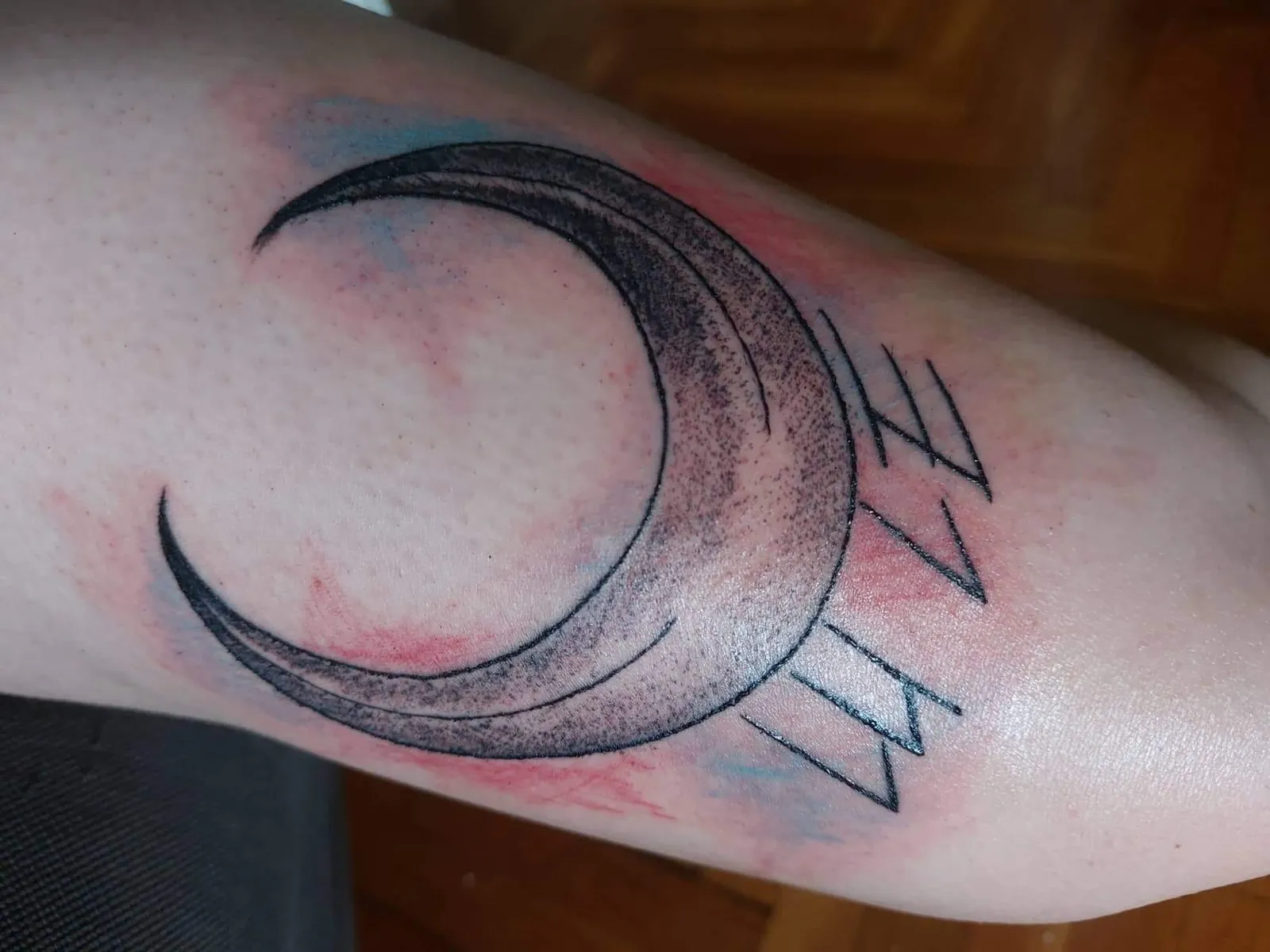
The crescent moon is the clearest dotwork piece here. All the shading inside its fine black outlines is stippling, thick in the wide part of the crescent and thinning out towards the tips. A soft wash of pink and blue sits behind it, with a short row of angular linework symbols along one side, and that background ties it to my colour and watercolour tattoos.
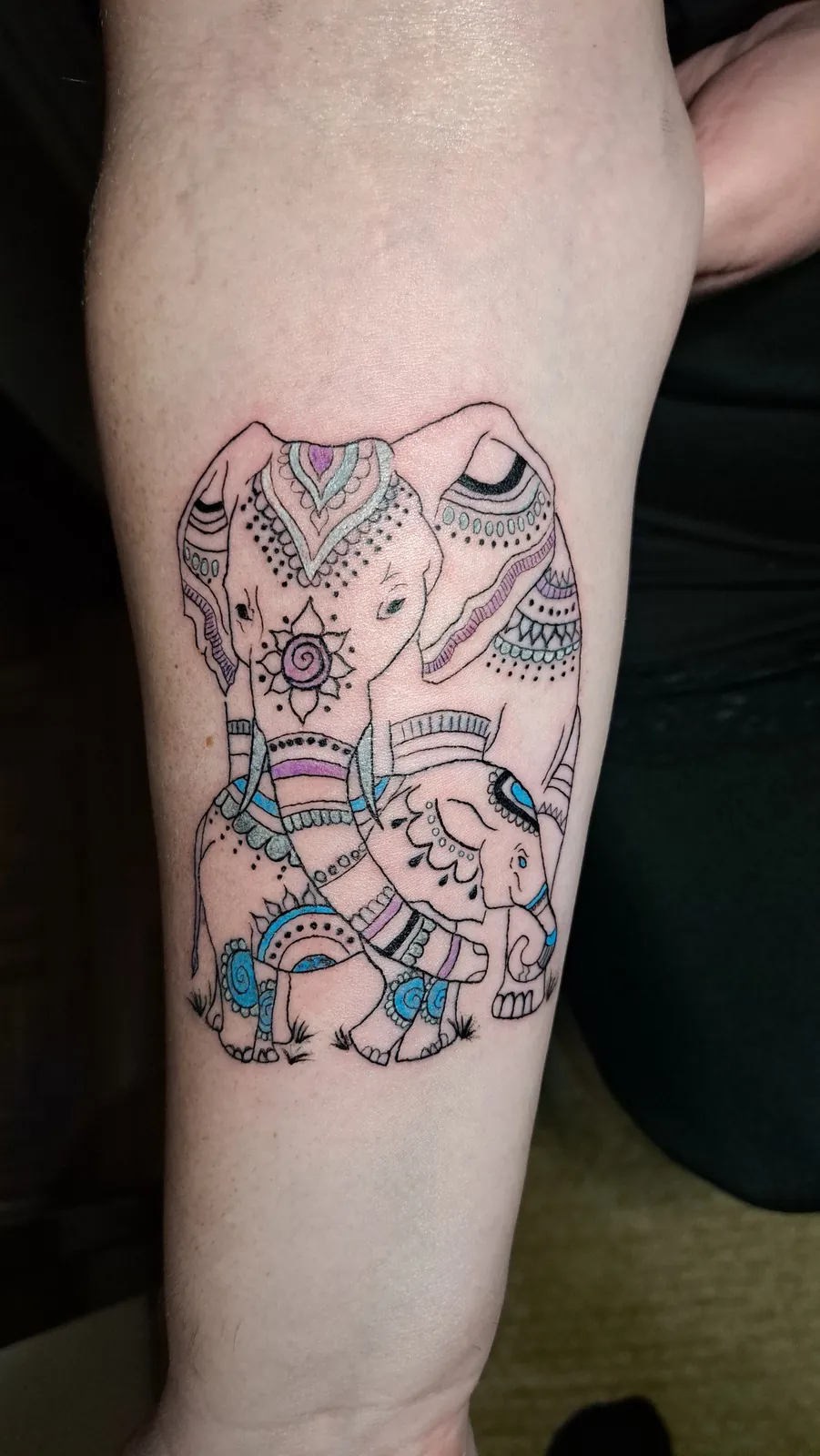
On a forearm, an ornamental elephant walks with a smaller one at its side. Mandala patterns and rows of dots fill their heads and ears, and a spiral flower sits on the larger elephant's face. Small touches of pink, blue, and turquoise stay inside the thin black linework instead of covering it.
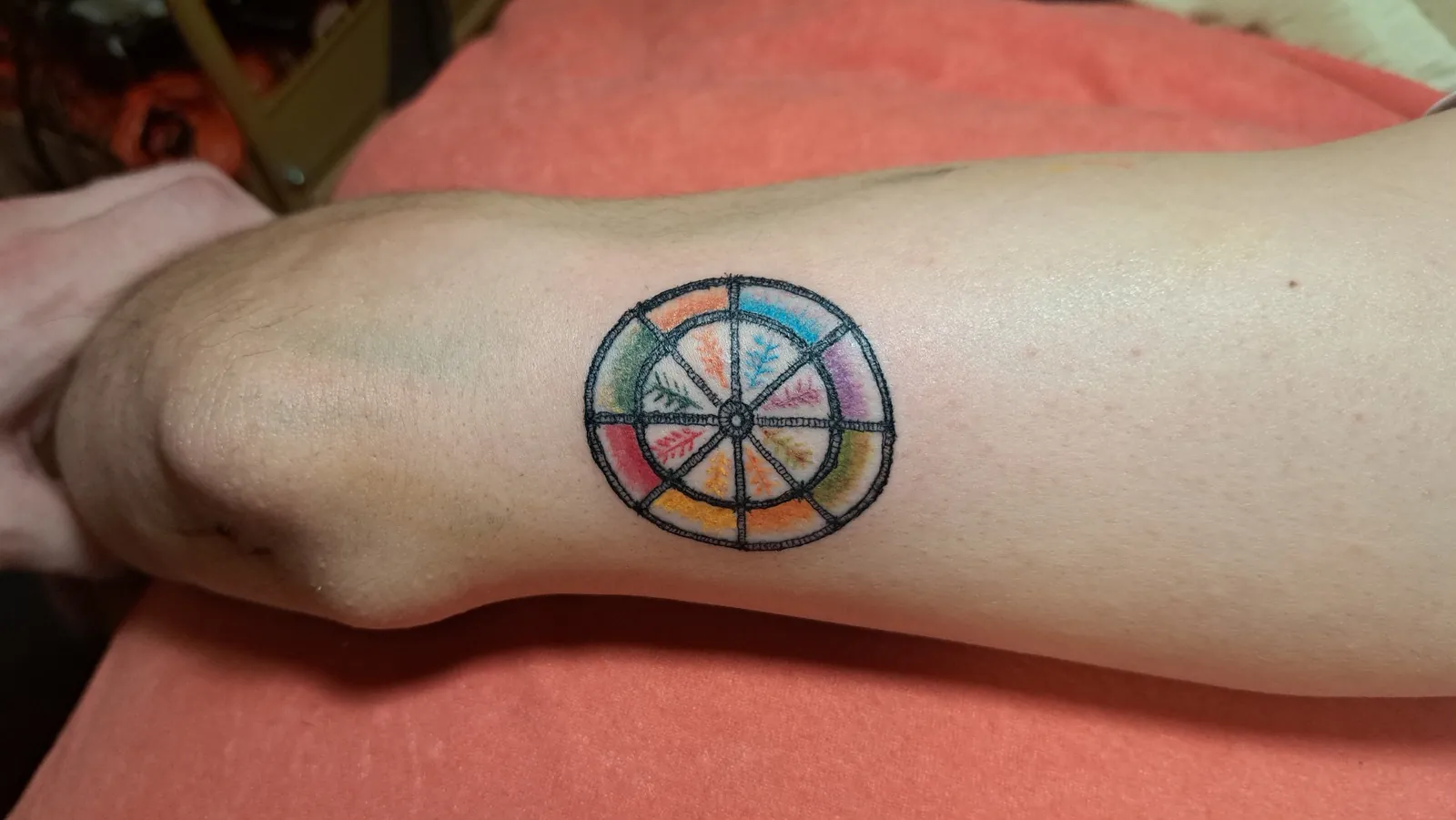
Not every ornamental tattoo needs dots. The colour wheel, also on a forearm, is a circle split into eight coloured segments around a small hub, with little leaf sprigs on the inner ring. Its strict radial symmetry is what makes it ornamental.
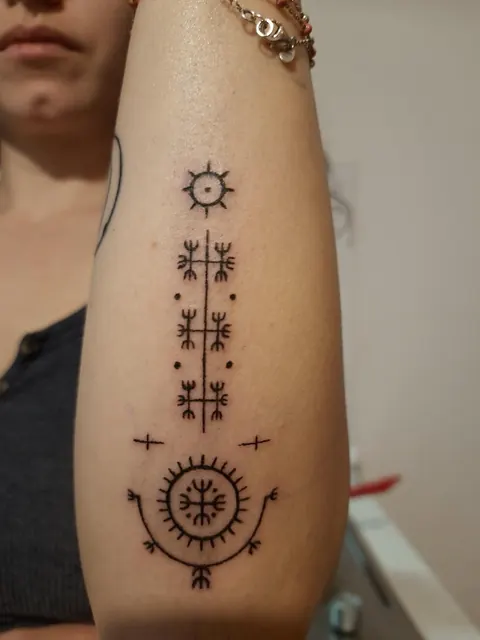
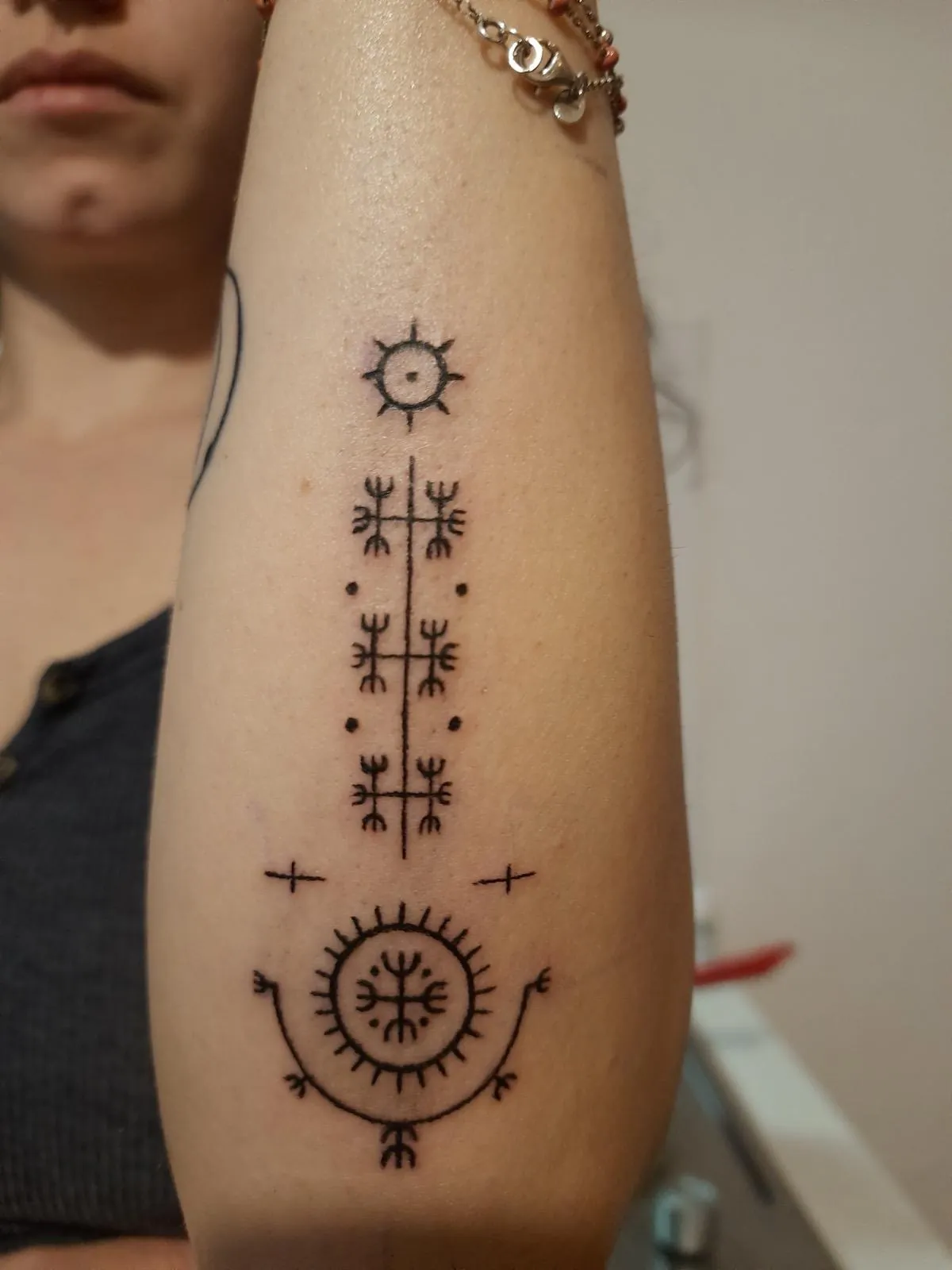
Last comes a column of Nordic-style stave symbols down the forearm, from a small sun down to a ringed circle at the bottom. It is pure linework, close to my fine line and linework tattoos, yet its mirror symmetry is ornamental. More photos are in the gallery.
Bosnian motifs in vertical linework
Ornament has roots where I come from, too. I am from Bihać, in Bosnia and Herzegovina, and traditional Bosnian Catholic tattoos, a tradition that began during the Ottoman occupation, are part of that background.
I took them as the starting point for Tattoo Pink, a brand concept for a tattoo ink company. Its logo joins the vertical linework of those traditional symbols with Bosančica, the old Bosnian Cyrillic script, and the whole concept is in the Tattoo Pink project.
Placing and healing a symmetrical design
Symmetry is unforgiving on a curved body. A mandala set slightly off the axis of a forearm looks tilted whenever the arm turns, and a circle over a rounded area can stretch into an oval. Long, straight areas such as the forearm or the calf give a symmetrical design a clear axis.
Before anything is final, check the stencil in a mirror while you stand naturally, arm relaxed. My guide to tattoo placement and pain compares the areas of the body.
Healing dotwork takes some patience. A fresh stippled area often looks uneven or a little cloudy, and it flakes like any tattoo. Leave it alone, because picking or scratching damages fine dots easily.
Follow the instructions of the artist who tattooed you, and see a doctor if you notice signs of infection or an allergic reaction. The general steps are in my tattoo aftercare guide.